How leg veins work
Arteries carry oxygen-rich blood from the heart to the tissues, and veins return it to the heart. The heart pumps blood through the arteries, but it cannot push blood all the way back up through the leg veins against gravity.
In the legs, the return journey depends on the calf muscle pump and on one-way valves inside the veins. Each time the calf muscles contract they squeeze blood upwards, and the valves stop it falling back. This is why walking is good for your leg veins.
When the valves fail, blood flows backwards and pools in the lower leg. This is called venous reflux, and it is the usual cause of varicose veins (spatare in Afrikaans): enlarged, twisted veins that bulge from the surface of the skin.
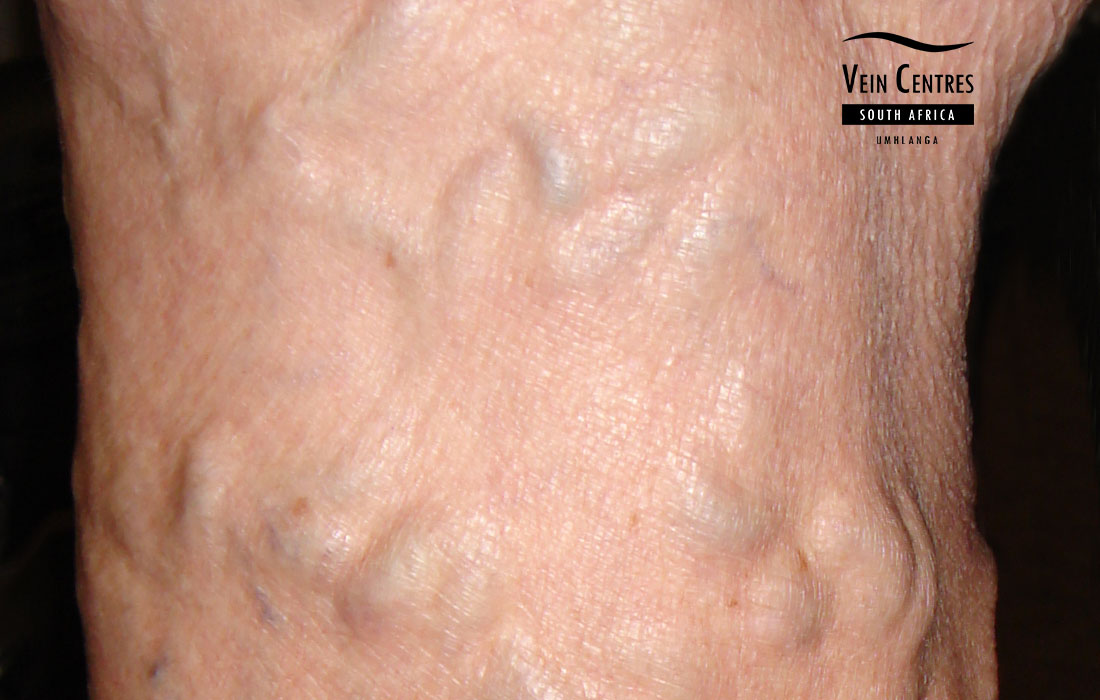


What are varicose veins?
The most common source of reflux is valve failure in one of the main superficial veins of the leg, the great or small saphenous vein. The bulging veins you see in the lower thigh, knee and calf are usually branches of a faulty saphenous vein higher up. Reflux stretches the vein and puts extra pressure on the valves below, so the problem tends to spread down the leg over time.
This is why the visible veins are not the whole story: treating only the veins you can see, without dealing with the faulty vein feeding them, often leads to them coming back.
Varicose veins are common, affecting about 3 in 10 adults, most often between the ages of 30 and 70. Women seek treatment more often than men.
Symptoms
Some people have no symptoms at all. Others have aching, heavy or tired legs, especially at the end of the day or after long periods of standing or sitting. Common symptoms include:
- aching, burning or heaviness in the legs;
- leg pain;
- ankle or leg swelling;
- night cramps and restless legs;
- itching, dry skin and eczema;
- darkening of the skin around the ankles (pigmentation) and changes in skin texture;
- open wounds that do not heal (leg ulcers).
An open sore on the leg or bleeding from a varicose vein needs prompt assessment by a vein specialist.
Causes and risk factors
The exact cause of varicose veins is not known. A number of factors are associated with weakening of the vein wall, which in turn leads to failure of the valves:
- family history;
- standing or sitting for long periods, for example in jobs such as teaching, nursing and pharmacy;
- pregnancy, and hormonal factors in women;
- higher body weight and greater height;
- previous leg injury;
- increasing age.
Studies have shown that increasing age, female sex, childbirth, standing at work, higher weight or height, and a positive family history are significantly associated with varicose veins1. Family history is an important association, but less important than was previously thought2. Hormonal factors, including puberty, pregnancy, menopause, the contraceptive pill and hormone therapy, also play a part.
In pregnancy, varicose veins usually appear from the second trimester onwards. Higher hormone levels and a larger blood volume soften and enlarge the veins, and the growing womb obstructs blood flow out of the legs. Varicose veins due to pregnancy frequently improve or resolve over the months after delivery, but veins still present six to twelve months after delivery are unlikely to resolve on their own. With successive pregnancies, abnormal veins are more likely to remain. See varicose veins in pregnancy.
Rarely, a blockage or other abnormality of the large veins in the abdomen causes varicose veins3. Treating the leg veins alone may then be ineffective or inappropriate, which is one reason specialist assessment matters.
Complications
The severity of symptoms does not always match what the veins look like. Some people with small varicose veins have considerable pain, while others with large veins have none. People with reflux in both legs often do not know what normal legs feel like, and many report that their legs feel lighter and more comfortable after treatment, although the degree of improvement varies.
Leg ulcers
The most serious complication is a venous leg ulcer. Persistently raised pressure in the veins damages the skin and the tissue beneath it, so small injuries heal slowly and can break down into an ulcer, usually around the ankle.
Without treatment of the underlying cause, ulcers often enlarge or keep recurring, and some remain open for years, with a large effect on quality of life. Rarely, a long-standing ulcer can undergo cancerous change, which is why an ulcer that behaves unusually should be biopsied.
Healing depends on treating the cause as well as the wound. With dressings and compression alone, many ulcers heal but then recur. In the EVRA trial, ulcers healed significantly faster when the underlying superficial reflux was treated early with endovenous ablation, rather than with compression alone4. NICE recommends referring anyone with a leg ulcer that has not healed within two weeks, or with a healed venous leg ulcer, to a vascular service for assessment that includes duplex ultrasound6. Where clinically significant superficial reflux is found, early endovenous treatment should be considered alongside compression and wound care. See venous leg ulcers.

Venous eczema
Venous eczema looks much like ordinary eczema and can occur whether or not you have eczema elsewhere. It is caused by the raised venous pressure in the lower leg. Dr Blignaut describes it to patients as an SOS from the skin.
Steroid creams usually clear an episode, but it tends to return, and regular moisturising reduces flare-ups. Treating the underlying reflux addresses the cause rather than the symptom.

Itching
Itching is a common symptom, often with dry skin over the lower leg.
Leg pain
Pain may be the main or only symptom, whether the veins are large or small. Pain from venous reflux follows a typical pattern: the legs feel fine in the morning and become more painful and heavy as the day goes on. It is often worse with prolonged standing, in hot weather and around menstruation, and may be felt as a dull ache or only on going to bed.
Raising the legs usually eases venous pain. If raising your legs makes the pain worse, the arteries may be the problem, and this needs to be checked. In more advanced disease, pain can start as soon as you stand, as blood flows the wrong way down the enlarged veins.
Superficial thrombophlebitis
A varicose vein can become hard, tender, red and warm, either on its own or after a minor knock. This is usually a clot in the surface vein, caused by slow, turbulent blood flow, and the redness is inflammation as the body breaks the clot down. It is not an infection and usually does not need an antibiotic.
Superficial vein thrombosis is different from deep vein thrombosis, but in some patients the clot extends towards or into the deep veins. The risk depends on where the clot is, how long it is and your individual risk factors, so a duplex scan and sometimes anticoagulation are needed5. Any new hard, red, tender vein should be assessed rather than assumed to be harmless. See superficial thrombophlebitis.
Cramps and restless legs
Night cramps, particularly in the calves and feet, and restless legs towards the end of the day are reported by many people with varicose veins, although the link is not well understood and both have other causes.
Swelling
More advanced venous disease can cause ankle swelling, usually worse by the end of the day. Leg swelling has many other causes too; see when leg swelling is, and is not, caused by veins.
Lipodermatosclerosis
In lipodermatosclerosis the skin and the fat beneath it, around and just above the ankle, become hard, tight and discoloured, as long-standing venous hypertension replaces healthy tissue with scar tissue. The changes are often permanent. In some people the lower leg narrows while the calf above stays full, giving an "inverted champagne bottle" shape.
In its early, acute phase the skin is red, warm and tender, and it is often mistaken for cellulitis and treated with antibiotics. Acute lipodermatosclerosis is a sign of skin at risk and needs assessment and treatment of the underlying reflux.

Bleeding from a varicose vein
A varicose vein under thin skin can bleed after little or no injury, often in the bath or shower. Lie down, raise the leg above the level of your heart and press firmly on the bleeding point, then apply a firm dressing. If bleeding does not stop with pressure and elevation, call 10177 or 112. A vein that has bled is likely to bleed again and should be assessed and treated by a vein specialist.
Tired, heavy legs
Tired, heavy legs after prolonged standing are common, and some people avoid standing in queues because of them. Treating the underlying reflux usually improves this symptom considerably. Class 2 graduated compression stockings give temporary relief.
Diagnosis
Venous duplex ultrasound is the investigation of choice for vein disease. It shows the anatomy of the veins and the direction of blood flow within them, so it identifies exactly which veins are refluxing. It uses no radiation and involves no needles. Every new patient at our centres has a duplex scan of both legs before any treatment is recommended.
We do not diagnose reflux with older bedside methods such as the Trendelenburg or tourniquet tests, or with a hand-held Doppler, which are less accurate than duplex. A hand-held Doppler is used only to measure the ankle–brachial pressure index (ABPI), which checks the arteries before compression.

Treatment
The aims of treatment are to relieve symptoms, prevent complications and, for many people, improve appearance. Lifestyle measures and compression can relieve symptoms but will not remove varicose veins. For varicose veins that cause symptoms, a procedure to close the faulty vein is usually the most effective treatment. Some people choose a procedure to improve how their legs look.
Lifestyle measures
Simple measures can reduce aching and swelling:
- take breaks from prolonged standing or sitting;
- walk and exercise your legs every day;
- if you are overweight, losing weight helps;
- avoid tight shapewear and tight clothing around the legs;
- raise your legs when you can;
- wear graduated compression stockings.
Procedures we offer
Modern procedures close the faulty vein rather than removing it. Closing a varicose vein does not harm the circulation, because blood redirects through healthy veins. You may need one procedure or a combination. Mild bruising, tenderness and some skin discolouration are common for a short time afterwards. All are done in our rooms under local anaesthetic.
Radiofrequency ablation passes a thin catheter into the faulty vein and heats its wall to a controlled temperature, sealing it shut. It is our most commonly used treatment for reflux in the main saphenous veins.
Medical adhesive (glue) closure seals the main vein with medical glue instead of heat. Only one needle puncture is needed per vein, because no local anaesthetic has to be injected along it.
Ultrasound-guided foam sclerotherapy uses ultrasound to guide an injection of foam into twisted veins, branch veins and veins that have come back after earlier treatment, causing them to close.
Sclerotherapy for spider veins treats the fine spider veins of the legs with injections, done by our nursing sisters. Spider veins on the face are better treated by a dermatologist with laser, intense pulsed light or electrosurgery.
Other procedures
Endovenous laser ablation (EVLA) works in the same way as radiofrequency ablation, using laser energy, with broadly similar results. We do not offer it.
Mechanochemical ablation (MOCA, ClariVein™) uses a catheter with a rotating tip while a sclerosant is injected, without local anaesthetic along the vein. We do not offer it.
Prevention
On current understanding, varicose veins cannot be prevented. The lifestyle measures above may slow their progression and ease symptoms.
References
- Ahti TM, Mäkivaara LA, Luukkaala T, Hakama M, Laurikka JO. Risk indicators for varicose veins in forty- to sixty-year-olds in the Tampere varicose vein study. World J Surg. 2002;26(6):648–51. PubMed 12053212
- Ahti TM, Mäkivaara LA, Luukkaala T, Hakama M, Laurikka JO. Effect of family history on the incidence of varicose veins: a population-based follow-up study in Finland. Angiology. 2009;60(4):487–91. PubMed 19625267
- Veller M. Varicose veins: look before you strip – the occluded inferior vena cava and other lurking pathologies. S Afr Med J. 2014;104(10):668–70. PubMed 25363049
- Gohel MS, Heatley F, Liu X, et al; EVRA Trial Investigators. A randomized trial of early endovenous ablation in venous ulceration. N Engl J Med. 2018;378(22):2105–14. NEJM
- Decousus H, Prandoni P, Mismetti P, et al; CALISTO Study Group. Fondaparinux for the treatment of superficial-vein thrombosis in the legs. N Engl J Med. 2010;363(13):1222–32. NEJM
- National Institute for Health and Care Excellence. Varicose veins: diagnosis and management (CG168). 2013. NICE CG168
Not sure which treatment is right for you? See our side-by-side comparison of the treatments, and how the choice is made.