We do not offer laser ablation at our centres. This page explains the technique because patients often ask about it. For the same kind of vein we use radiofrequency ablation, which closes the vein with heat in the same way, or medical adhesive (glue) closure where avoiding heat matters. Your duplex scan decides which suits you.
The circulatory system is made up of both veins and arteries. Arteries deliver fresh oxygen-rich blood from the heart to all tissues and veins then collect the oxygen-depleted blood again and transport it back to the heart. The heart will pump blood through the arteries, but not all the way through the veins.
In the lower limbs, blood requires a different transport system to return it, against gravity, back to the heart. This transport system is made up of a pump again, the “calf pump” and one way valves within the veins. It is for this reason that walking is a great way to keep your legs healthy, since the calf pump is activated all the time.
Broken one-way valves in the legs will cause blood to flow back through the vein and pool in the lower legs, this is known as venous reflux, and often presents as varicose veins. Varicose veins are large blue tortuous vessels that bulge from the surface of the skin.
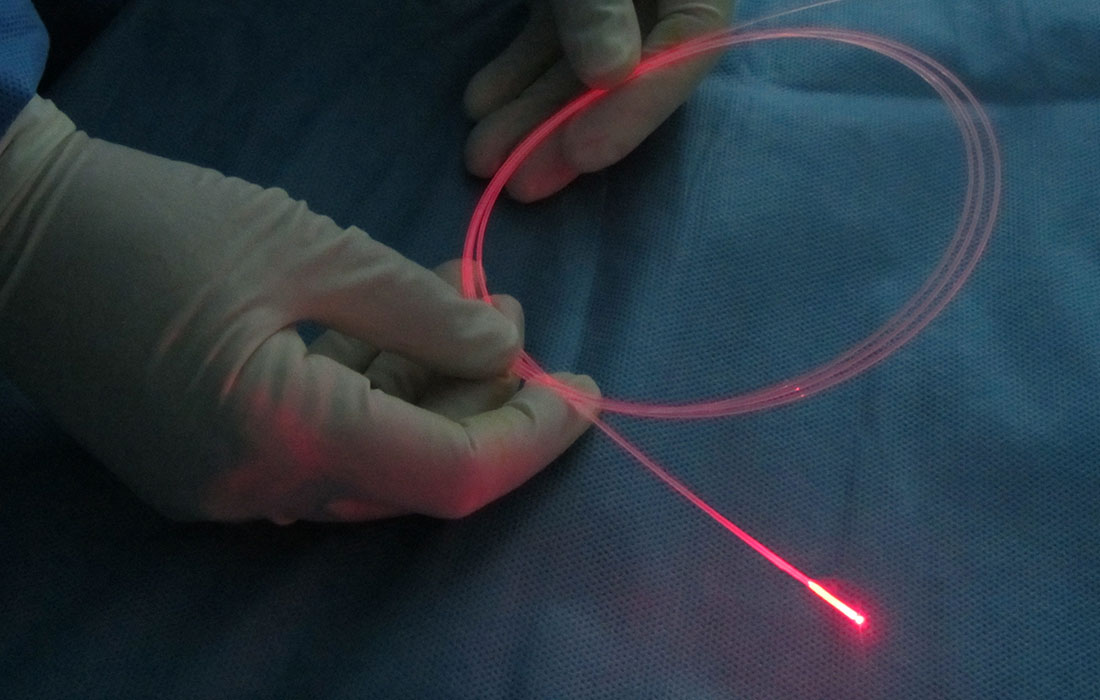
What is endovenous laser ablation?
Endovenous laser ablation, or EVLA, is a minimally invasive treatment for varicose veins caused by superficial venous reflux. A thin laser fibre is passed inside the faulty vein and heat is used to seal it closed from within. Blood then redirects naturally through the healthy veins, and the sealed vein is gradually absorbed by the body.
It is one of the two endovenous thermal techniques, the other being radiofrequency ablation. Both have replaced the open stripping operation for most suitable patients, and both are usually performed under local anaesthetic without hospital admission.
How the procedure works
Before treatment, the veins are mapped with duplex ultrasound, so that the plan is based on where the reflux actually arises rather than on which veins are visible.
On the day, a small needle is inserted into the vein, usually just below the knee. It is the same calibre as a routine drip needle. The needle is exchanged for a fine plastic cannula, through which the laser fibre is passed up inside the vein under ultrasound guidance.
A dilute mixture of saline and local anaesthetic is then injected around the vein along its length. This is called tumescent anaesthesia, and it does two jobs: it numbs the vein and it forms a protective layer of fluid between the vein and the surrounding tissues and nerves.
The laser is activated and delivers a measured amount of heat energy to the vein wall as the fibre is withdrawn. The collagen in the wall contracts and the vein seals shut. The cannula is removed and a layered bandage applied. The procedure takes 20 to 40 minutes.
Most patients report little or manageable discomfort during the procedure, and go home once it is complete.
Who it suits
Endovenous techniques have replaced traditional open surgery for many suitable patients12. The appropriate treatment depends on venous anatomy, reflux pattern, previous treatment and individual clinical circumstances. Open surgery remains appropriate in selected cases.
Patients with symptomatic superficial venous reflux demonstrated on a duplex scan are generally suitable candidates. Deep venous reflux does not by itself rule out treating the superficial veins: many patients with both still benefit. The decision depends on the duplex findings, your symptoms and skin changes, and whether there is any obstruction of the deep veins, for example after a previous DVT.
Other factors to consider include pregnancy and breastfeeding, a history of deep vein thrombosis, reduced mobility, and any anticoagulant or antiplatelet medication you take. Tell us about all your medication, and do not stop prescribed medication unless instructed to do so by the doctor who prescribed it.
Whether an endovenous treatment suits you is established by a duplex scan performed by a vein specialist.
Laser or radiofrequency?
Patients often ask which is better. Both are endovenous thermal techniques, both close the vein with heat, and randomised comparisons and a meta-analysis of 29 studies have found broadly similar closure rates between them4.
There are differences in the detail. Laser delivers energy at a higher peak temperature at the fibre tip, while radiofrequency heats a segment of vein to a controlled temperature along a heating element. Some studies have reported slightly more post-procedure bruising and discomfort in the first week after laser, though this difference narrows with modern fibres and wavelengths34.
Current European guidelines regard the two as comparable1. At our centres we use radiofrequency ablation as our thermal technique, and medical adhesive closure or ultrasound-guided foam sclerotherapy where the vein anatomy suits them better. Which is used in your case is decided after your duplex scan and discussed with you beforehand.
Recovery
After endovenous thermal ablation a bandage or compression stocking is usually worn for a period, as instructed.
Walk every day from the outset. Walking is actively encouraged and helps reduce the risk of clot formation. Avoid strenuous activity, heavy lifting and hot baths for about a week. Most patients resume their normal daily activities within a day or two.
Mild tenderness, bruising and a tight or pulling sensation along the treated vein are common in the first two weeks as the sealed vein contracts. This settles on its own. Where further work is needed on surface branches, this is often done at a later session.
Risks and side effects
Endovenous laser ablation is well tolerated, but as with any procedure there are risks worth understanding beforehand.
Common and temporary. Bruising along the treated vein, tenderness, and a tight cord-like sensation as the vein contracts over the following weeks. Numbness or tingling in a small patch of skin can occur where a sensory nerve runs close to the treated vein, and usually resolves.
Less common. Superficial thrombophlebitis in a surface branch, skin discolouration over the treated vein, and infection at a puncture site.
Uncommon. Deep vein thrombosis, and extension of thrombus from the treated vein towards a deep vein junction. Walking regularly and wearing your compression as instructed reduce this risk. Report any new calf swelling, worsening pain, or breathlessness promptly.
Recurrence. Venous disease is progressive. Treatment addresses the reflux present today, but new areas of reflux can develop over time, and some patients need further treatment years later. * Individual results may vary.
At our centres
We do not offer laser ablation. If you have been told you need it, or you are comparing options, book a consultation: Dr Blignaut will scan both legs and explain whether radiofrequency ablation, glue closure or foam sclerotherapy suits your veins. How medical schemes pay is explained on our fees and medical aid page.
References
- De Maeseneer MG, Kakkos SK, Aherne T, et al. European Society for Vascular Surgery (ESVS) 2022 clinical practice guidelines on the management of chronic venous disease of the lower limbs. Eur J Vasc Endovasc Surg. 2022;63(2):184–267. ESVS guideline
- Gloviczki P, Lawrence PF, Wasan SM, et al. The 2022 SVS, AVF and AVLS clinical practice guidelines for the management of varicose veins of the lower extremities. Part I. J Vasc Surg Venous Lymphat Disord. 2023;11(2):231–61. Journal
- Almeida JI, Kaufman J, Göckeritz O, et al. Radiofrequency endovenous ClosureFAST versus laser ablation for the treatment of great saphenous reflux: a multicenter, single-blinded, randomized study (RECOVERY study). J Vasc Interv Radiol. 2009;20(6):752–9. Journal
- Wang X, Wang H, Zhang R, et al. Endovenous radiofrequency ablation vs laser ablation in patients with lower extremity varicose veins: a meta-analysis. J Vasc Surg Venous Lymphat Disord. 2024. PubMed 38316290
Not sure which treatment is right for you? See our side-by-side comparison of radiofrequency ablation, EVLA, glue closure and foam sclerotherapy, and how the choice is made.