
About Venaseal™ - Glue for Varicose veins
The circulatory system is made up of both veins and arteries. Arteries deliver fresh oxygen-rich blood from the heart to all tissues and veins then collect the oxygen-depleted blood again and transport it back to the heart.
The heart will pump blood through the arteries, but not all the way through the veins.
In the lower limbs, blood requires a different transport system to return it, against gravity, back to the heart. This transport system is made up of a pump again, the “calf pump” and one way valves within the veins.
It is for this reason that walking is a great way to keep your legs healthy, since the calf pump is activated all the time.
Broken one-way valves in the legs will cause blood to flow back through the vein and pool in the lower legs, this is known as venous reflux, and often presents as varicose veins. Varicose veins are large blue tortuous vessels that bulge from the surface of the skin.
VENASEAL™ Procedure
Can glue be used to treat Varicose Veins?
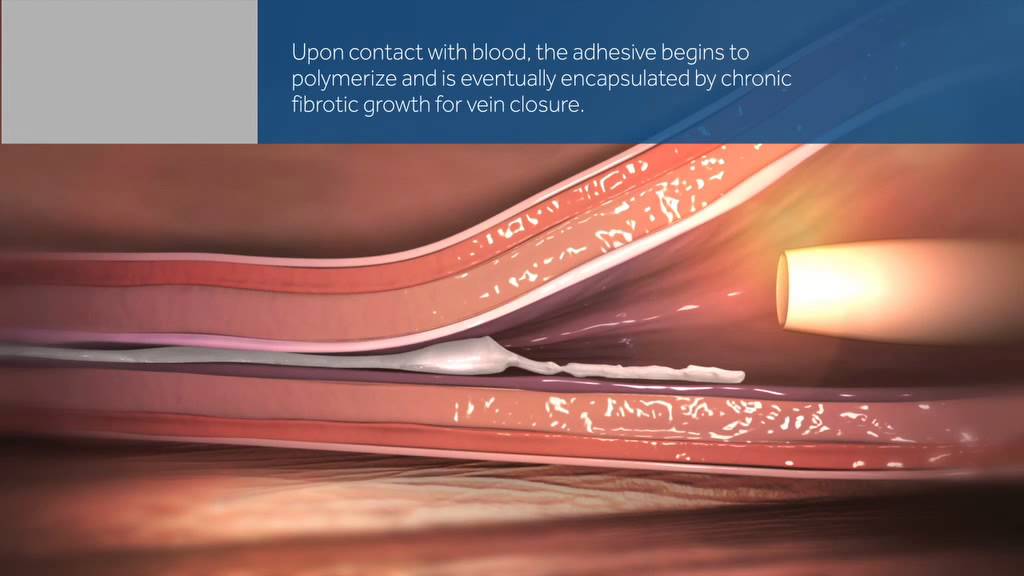
The Venaseal™ procedure is a minimally invasive in-office treatment for varicose veins and Chronic Venous Insufficiency (CVI) in which a vein specialist inserts a Venaseal™ Endovenous Catheter to deliver glue, collapse and close enlarged leg veins. After the vein is sealed shut, blood then naturally re-routes to other healthy veins in the leg.
How does it work?
The Venaseal™ procedure is performed in an office operating room under local anaesthetic, minimal preparation by the patient is required. It truly is a walk-in walk-out procedure that takes 20-30 minutes to perform. The procedure does not require hospital admission or a general anaesthetic.
To perform the Venaseal™ procedure, Dr Blignaut maps out the leg veins to be treated prior to surgery using a duplex ultrasound. During the procedure, a small needle is inserted just below the knee. (This needle is the same size as a regular drip in the arm). This needle is replaced by a plastic cannula that allows for the passage of the Venaseal™ catheter into the vein. No further injections are required. Once the catheter has been placed under ultrasound guidance, a precise amount of glue is delivered to the vein. Mild pressure allows the vein to be glued shut immediately, leaving a sealed vein. Upon completion, the catheter is removed from the leg. Most patients report little or manageable discomfort during the procedure. Mild tenderness or bruising may occur afterwards. For anxious or needle phobic patients we can give a mild sedative before or during the procedure. Patients leave the room once the procedure is complete. If no sedation was used, they may drive themselves home.
You will be encouraged to walk every day, but to refrain from strenuous activity for at least a week. Most patients who undergo Venaseal Glue treatment of their varicose veins typically resume normal activities within a day.
Is Venaseal Glue treatment right for me?
Endovenous techniques have replaced traditional open surgery for many suitable patients12. The appropriate treatment depends on venous anatomy, reflux pattern, previous treatment and individual clinical circumstances. Open surgery remains appropriate in selected cases.
Cyanoacrylate closure has a particular advantage over the thermal techniques: because it seals the vein with an adhesive rather than heat, no tumescent anaesthetic is required. That means a single needle puncture per vein rather than a series of injections along its length, and no risk of thermal injury to nearby nerves. Some patients find this preferable, and it can suit veins in positions where heat would be less appropriate.
Patients with superficial vein reflux, as demonstrated on a duplex scan, are generally suitable candidates for this procedure. Deep venous reflux, usually the result of a previous DVT, may influence whether superficial vein treatment is appropriate and is assessed individually on duplex ultrasound. The only way to establish whether glue closure suits you is a duplex scan performed by a vein specialist.
Your assessment is performed by Dr Johan Blignaut and includes duplex mapping before treatment is recommended. Treatment is selected according to your venous anatomy, not simply according to the veins visible on the skin.
Venaseal is a newer treatment option than radiofrequency or laser ablation, and is now supported by published long-term outcome data. It is not funded by most South African medical schemes, which is a practical consideration in choosing between it and the thermal techniques — see the pricing section below.
Pricing and Medical Schemes
Cyanoacrylate glue closure is generally not funded by South African medical schemes, and in most cases the procedure is payable by the patient. Cover can differ between schemes and between options, so we confirm your individual benefits before your procedure rather than relying on general guidance.
For current scheme and pricing information, please see our medical schemes and pricing page, or contact your nearest vein centre and we will check your specific benefits.
Venaseal™ Procedure Video
Venaseal™ Patient experience
References
- De Maeseneer MG, Kakkos SK, Aherne T, et al. European Society for Vascular Surgery (ESVS) 2022 clinical practice guidelines on the management of chronic venous disease of the lower limbs. Eur J Vasc Endovasc Surg. 2022;63(2):184–267. ESVS guideline
- Gloviczki P, Lawrence PF, Wasan SM, et al. The 2022 SVS, AVF and AVLS clinical practice guidelines for the management of varicose veins of the lower extremities. Part I. J Vasc Surg Venous Lymphat Disord. 2023;11(2):231–61. Journal
Not sure which treatment is right for you? See our side-by-side comparison of radiofrequency ablation, EVLA, VenaSeal and foam sclerotherapy, and how the choice is made.
Written and medically reviewed by Dr Johan Blignaut, MBChB (UOFS), FCS(SA)SURG, Specialist Surgeon.
Last medically reviewed: August 2026. This page is reviewed periodically and updated when clinical practice changes. It is general information, not medical advice – see our terms and medical disclaimer.